
Description
Secure Passkeys is a powerful WordPress plugin that enables seamless passwordless authentication using WebAuthn technology. By eliminating the need for traditional passwords, it enhances security and improves the user login experience. With support for biometric authentication, security keys, and device-bound credentials, Secure Passkey provides a robust and user-friendly solution for modern authentication.
Unlike traditional password-based authentication, Secure Passkey leverages cryptographic key pairs to ensure secure logins. The private key remains securely stored on the user’s device, while the public key is registered with the WordPress site. This method protects against phishing attacks and password breaches, ensuring that only authorized users can gain access.
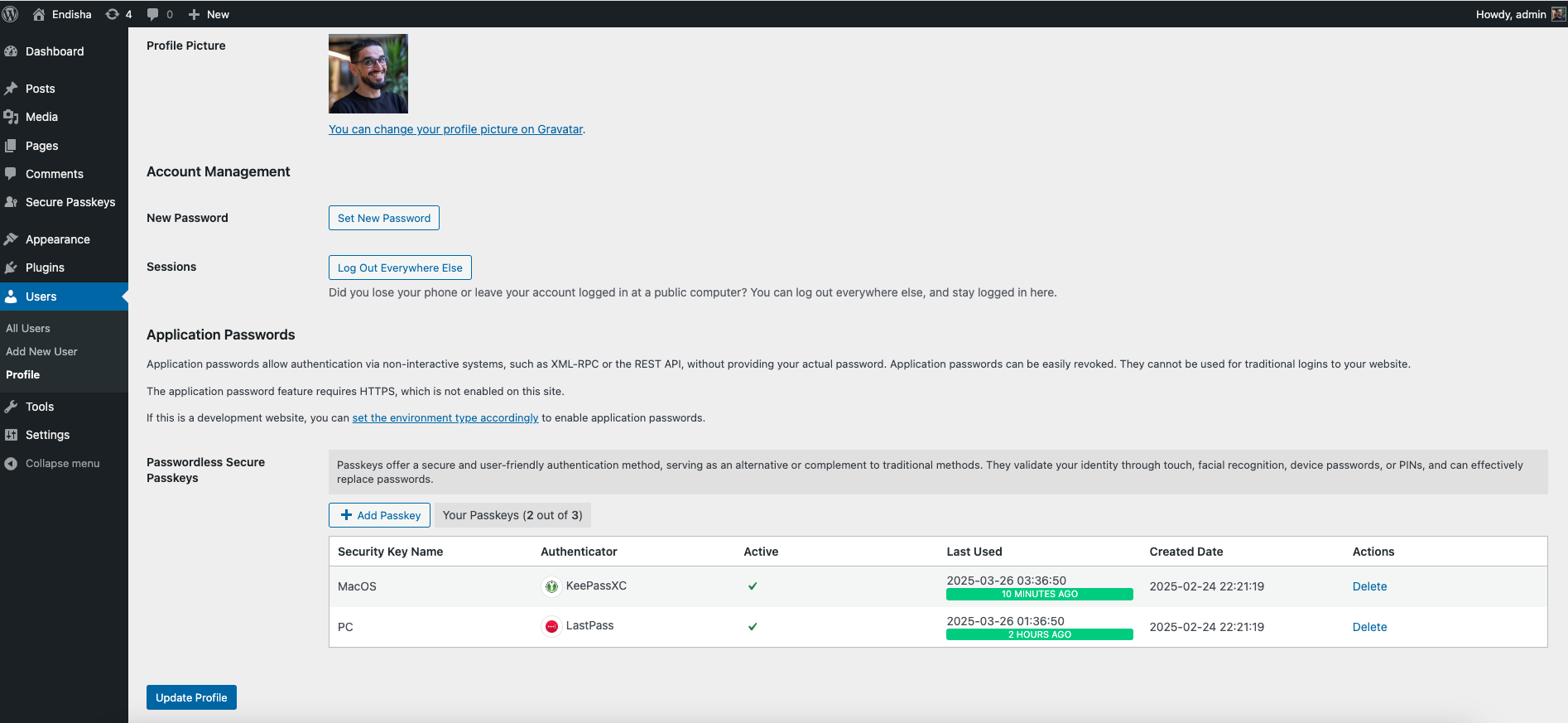
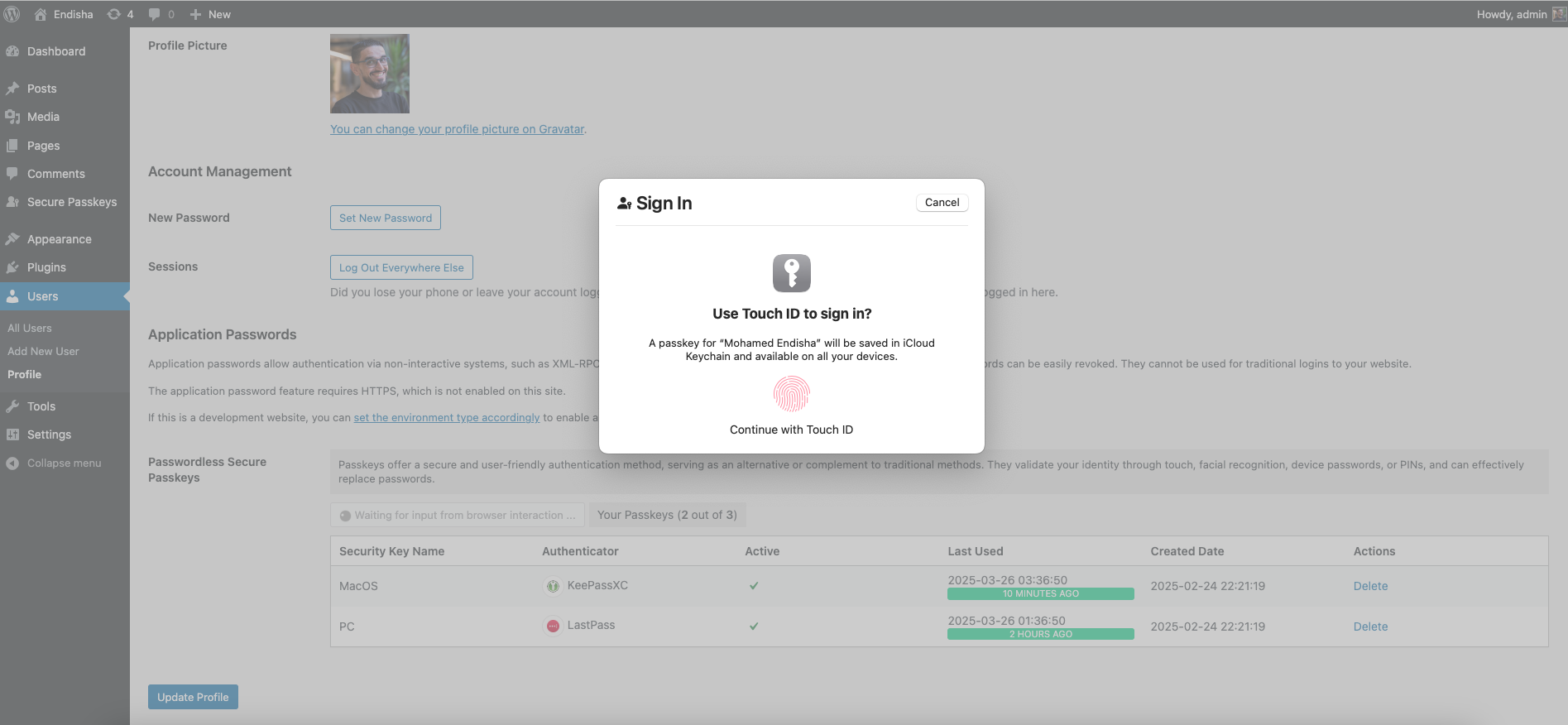
Secure Passkeys integrates effortlessly into WordPress, allowing users to register and manage their passkeys from their profile settings. Once registered, users can log in using their fingerprint, face recognition, or a hardware security key without the need to remember or enter a password.
Features
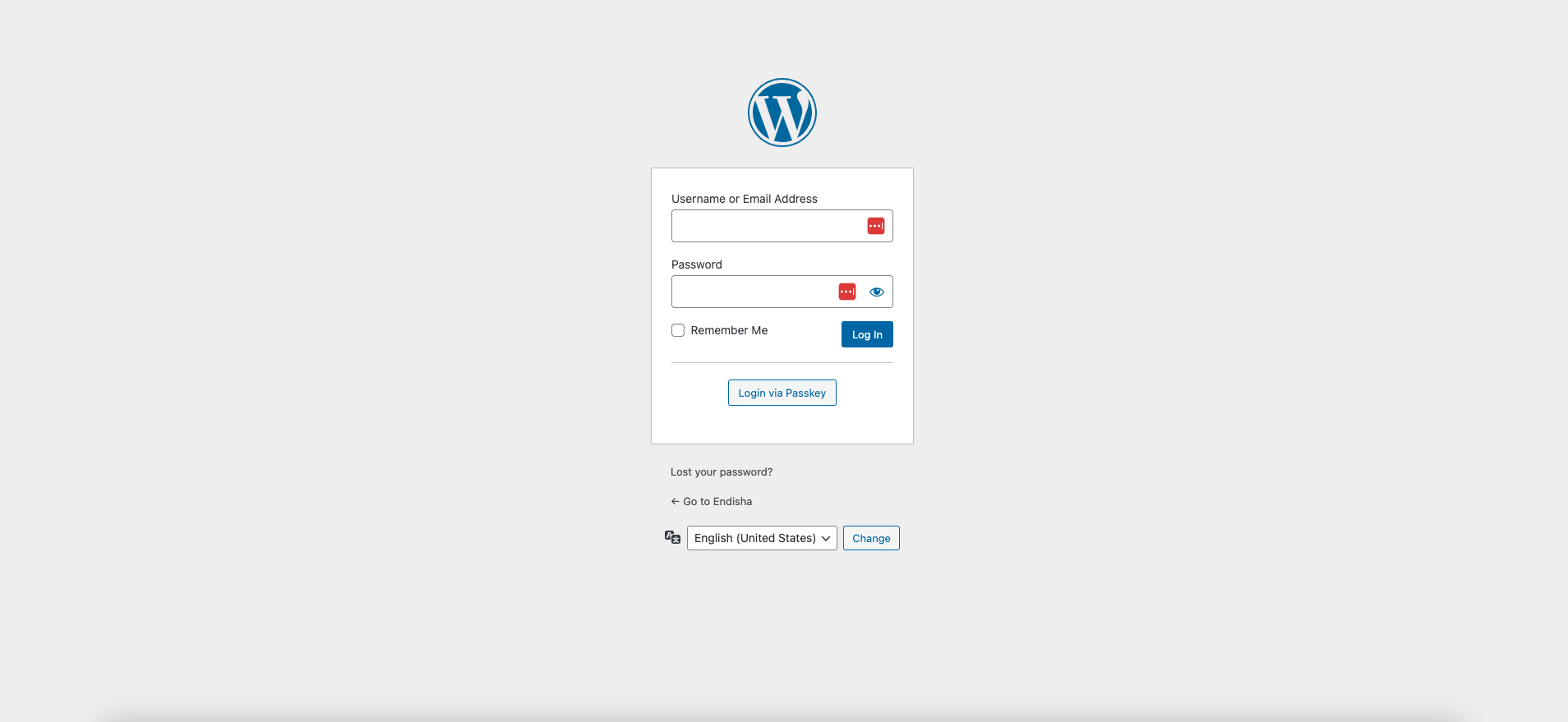
- Passwordless Login: Secure authentication via WebAuthn with biometric devices, security keys, Touch ID, Face ID, and more.
- Enhanced User Experience: Password-free login for a smoother user journey.
- Integration Support:
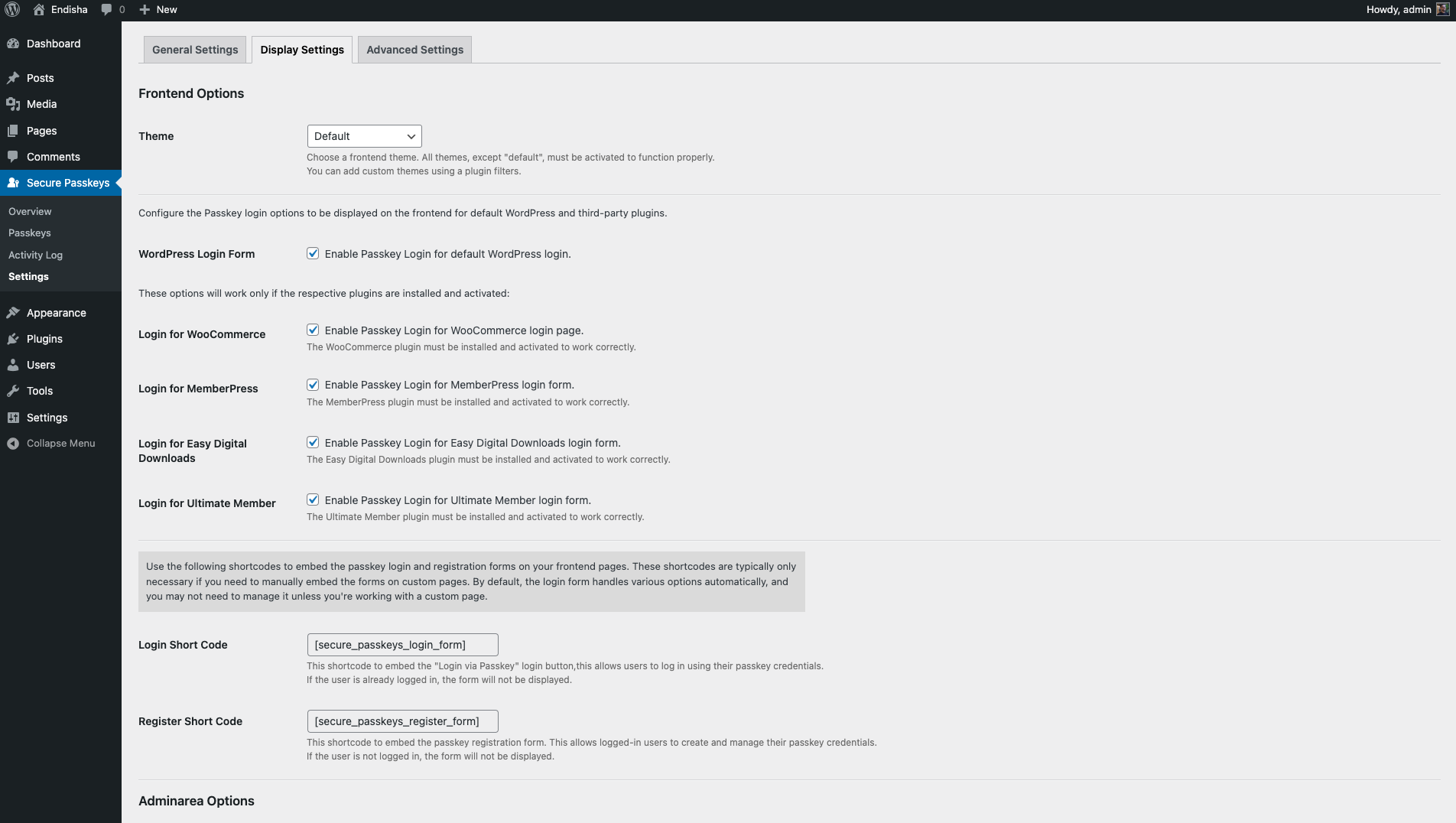
- WordPress default login form
- WooCommerce login page
- MemberPress login form
- Easy Digital Downloads login form
- Ultimate Member login form
- Admin Management: Administrators can delete, activate, or deactivate users directly from plugin settings or user profiles.
- Passkeys Reminder Notice: New option to enable or disable the passkeys reminder notice in the WordPress admin area for users who have not yet enabled passkeys.
- Activity Logging: Monitor activity logs and track last login/registration of passkeys.
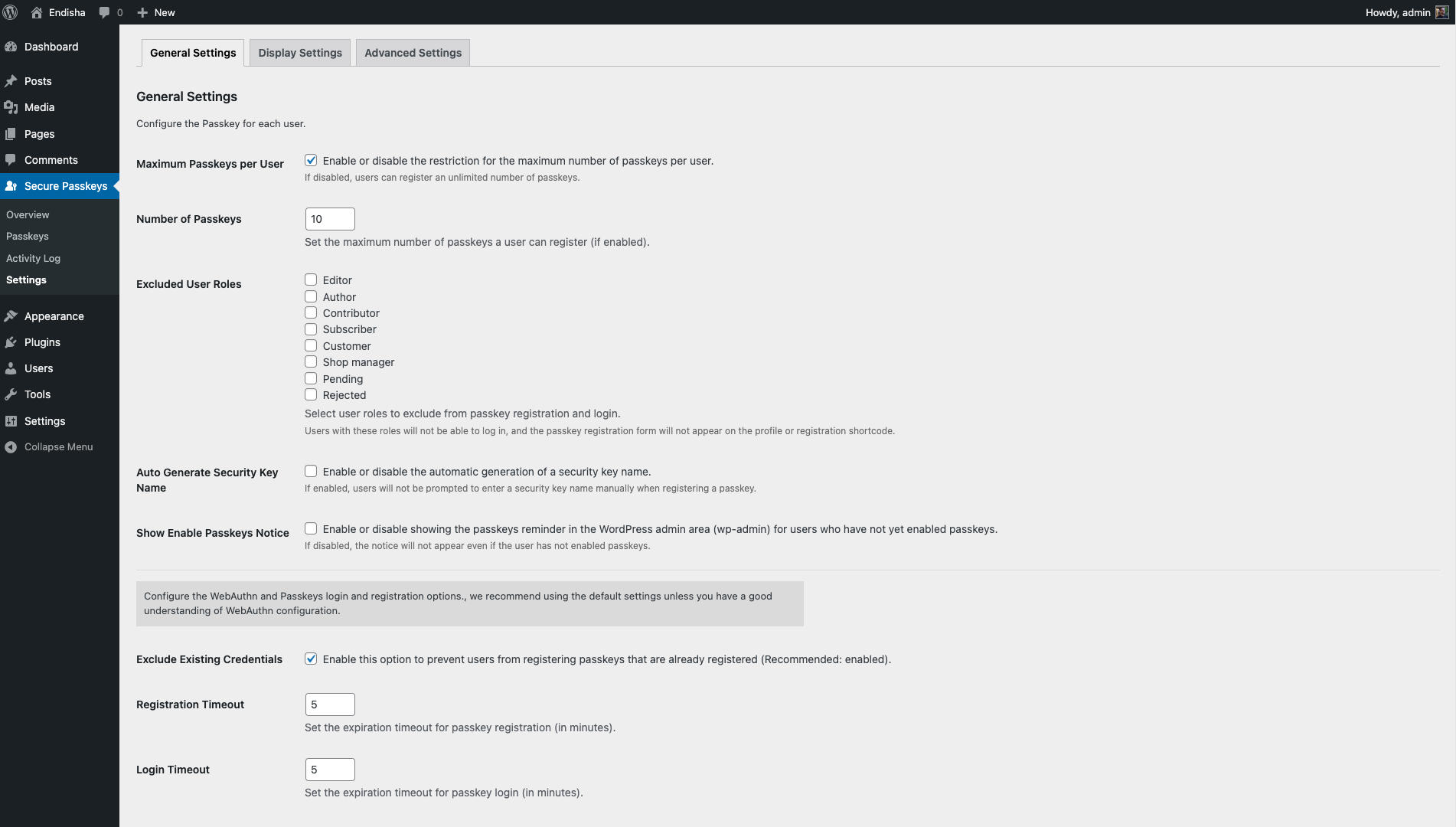
- Multiple Passkeys: Supports multiple passkey registrations per user, with the option to set a registration limit or allow unlimited registrations.
- Role Restrictions: Restrict and exclude specific user roles from using passkey authentication.
- Passkey Autofill: Passkeys automatically appear as a suggestion when clicking the username field — no button click required.
- Rate Limiting: Configurable rate limiting on login attempts to protect against automated attacks.
- Long-lived Session: Control whether passkey logins set a persistent session cookie or end when the browser is closed.
- Customizable Settings: Adjust timeout settings for passkey registration and login.
- User Verification: Enforce user verification for enhanced security.
- Frontend Customization: Easily customize frontend themes or add your own with basic frontend skills.
- Theme Support: Supports pre-built themes like YOOtheme (UIkit) for frontend shortcodes.
- Shortcodes: Embed passkey login and registration forms on custom frontend pages.
- Passkey Display: Show passkey details in admin user lists and profiles.
- Multisite: Supports WordPress Multisite and single-site installations.
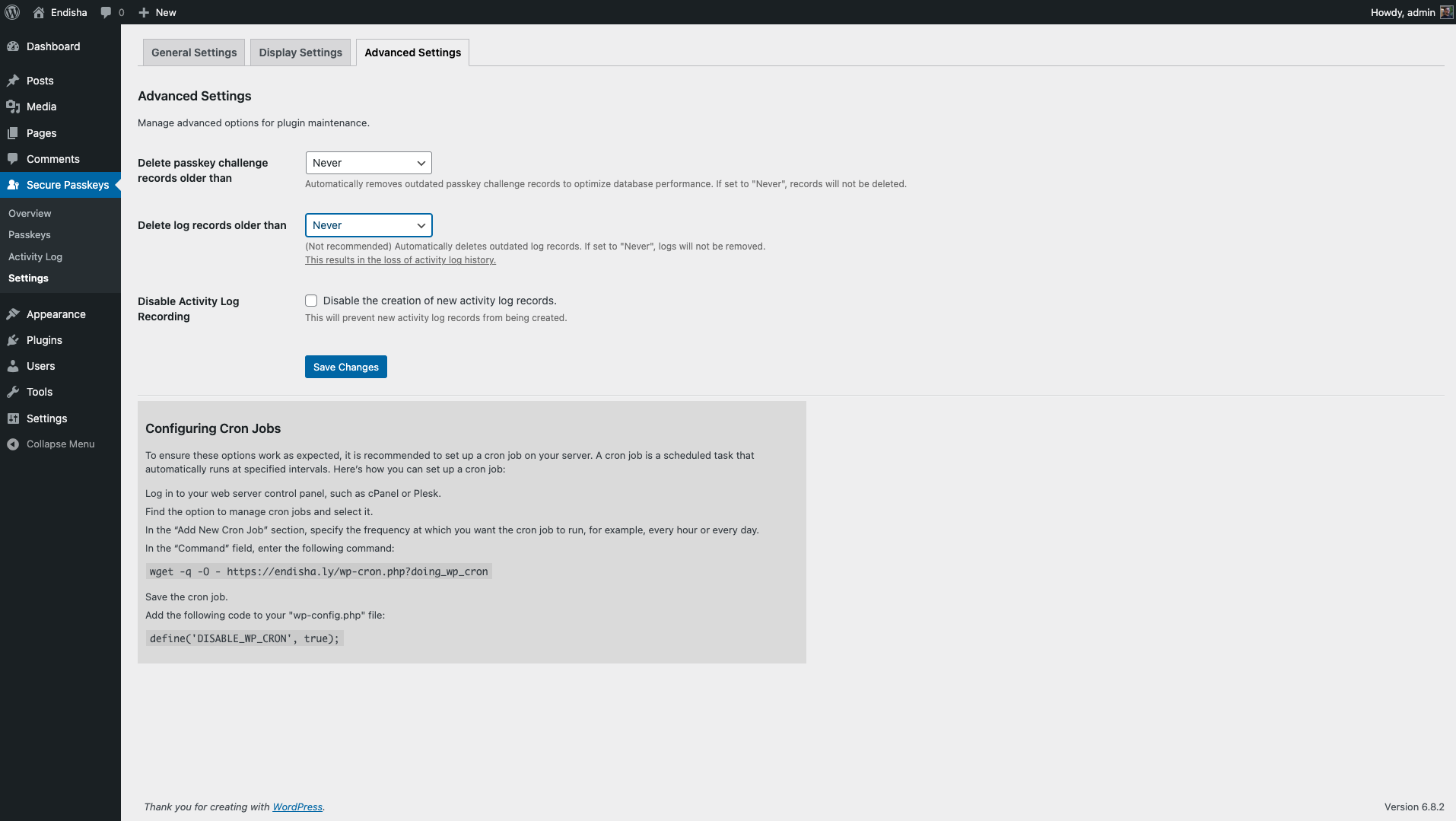
- Database Optimization: Option to allow or disallow automatic deletion of old challenge records and activity logs (configurable schedule).
Requirements
- WordPress 6.0 or newer.
- PHP version 7.4 or newer.
License
Secure Passkeys is licensed under the GNU General Public License v2 or later.
Screenshots
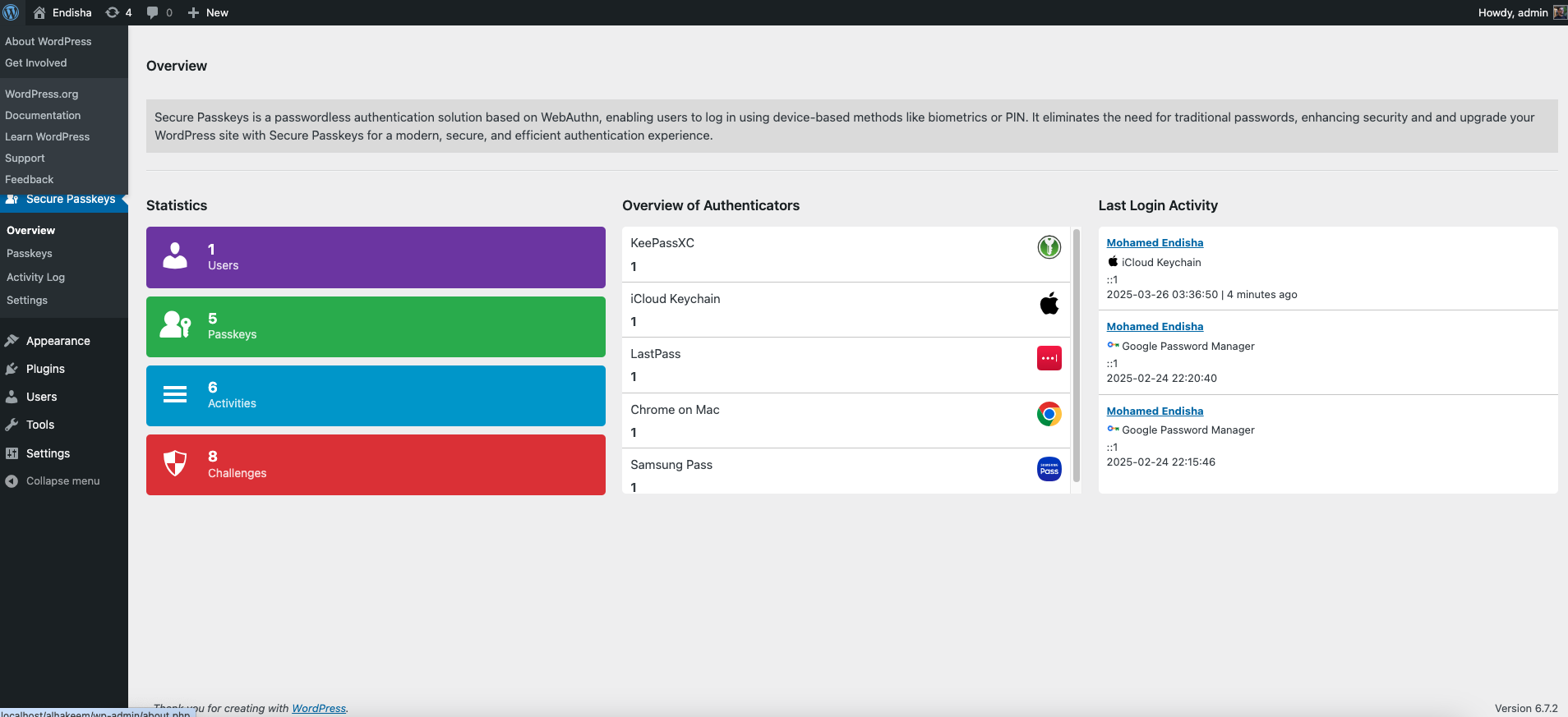
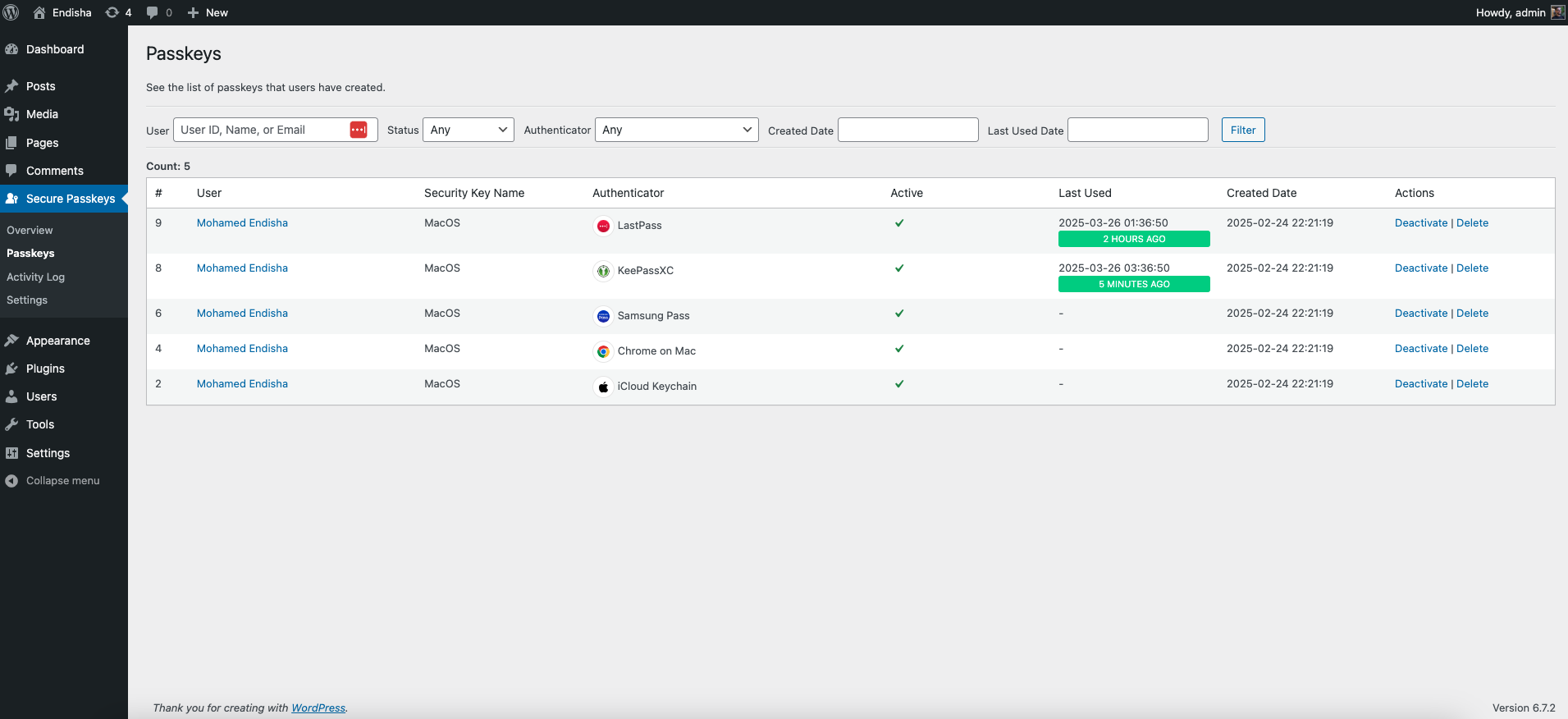
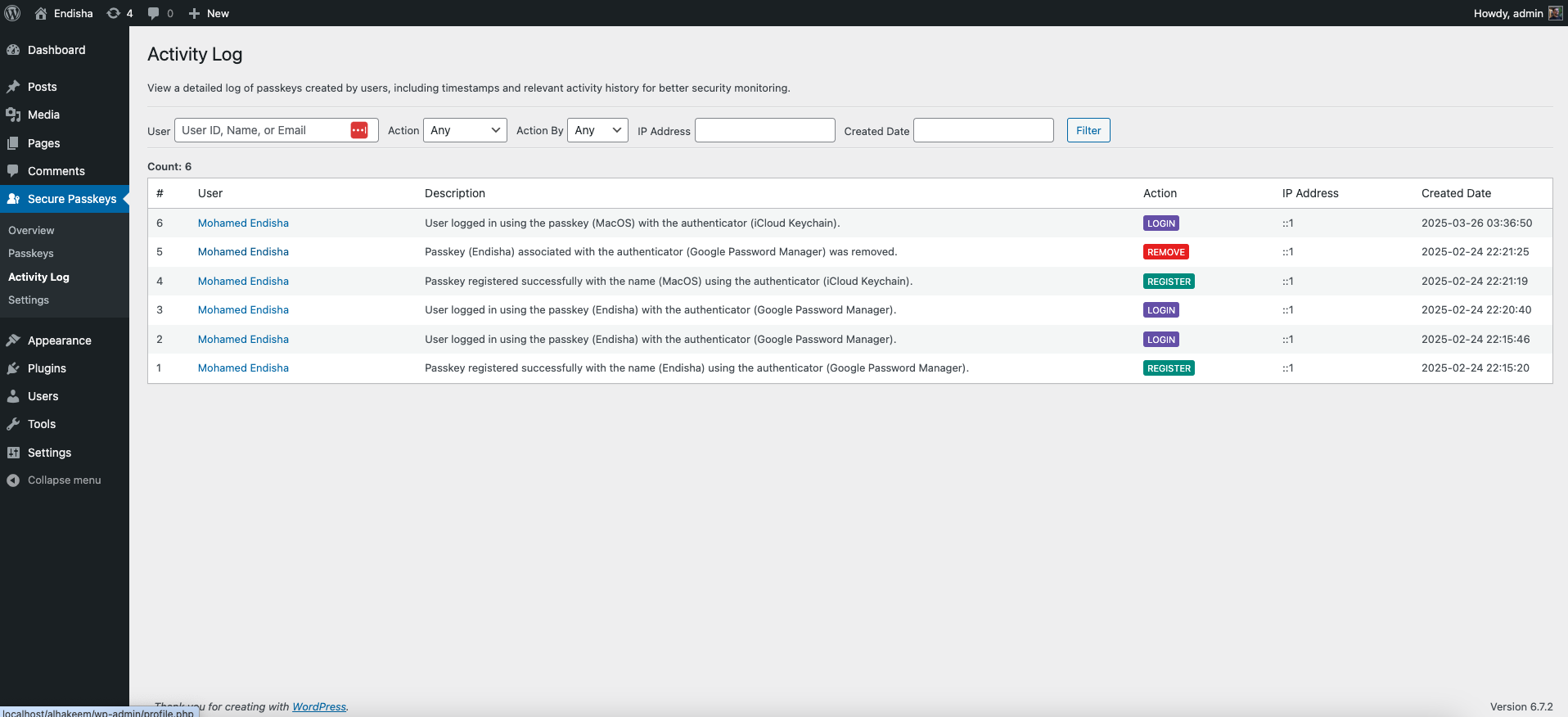
Installation
Minimum Requirements
- PHP 7.4 or greater is recommended
- MySQL 5.6 or greater is recommended
Automatic installation
Automatic installation is the easiest option — WordPress will handles the file transfer, and you won’t need to leave your web browser. To do an automatic install of Secure Passkeys, log in to your WordPress dashboard, navigate to the Plugins menu, and click “Add New.”
In the search field type “Secure Passkeys” then click “Search Plugins.” Once you’ve found us, you can view details about it such as the point release, rating, and description. Most importantly of course, you can install it by! Click “Install Now,” and WordPress will take it from there.
Manual installation
Manual installation method requires downloading the Secure Passkeys plugin and uploading it to your web server via your favorite FTP application. The WordPress codex contains instructions on how to do this here.
FAQ
-
How do I enable and configure the Secure Passkeys?
-
After activating the plugin, a “Secure Passkeys” menu item will appear in your WordPress admin dashboard’s sidebar.
-
How can I add a new theme for frontend shortcodes?
-
You can add a custom theme for frontend shortcodes using the
secure_passkeys_themesandsecure_passkeys_themes_pathsfilters.Register the Theme: Use the
secure_passkeys_themesfilter to register your new theme and make it available in the plugin settings.<?php add_filter('secure_passkeys_themes', function ($themes) { $themes['new_theme'] = 'New Theme'; return $themes; }, 10, 1);Specify the Theme Path: Use the
secure_passkeys_themes_pathsfilter to define the file path to your custom theme’s directory.<?php add_filter('secure_passkeys_themes_paths', function ($themes) { $themes['new_theme'] = 'your/path/new/theme/folder'; return $themes; }, 10, 1);Override Template Files: Copy the template files you wish to customize from
secure-passkeys/src/views/frontend/default/to your custom theme’s folder (your/path/to/new/theme/folder). Any files not copied to your custom theme folder will be loaded from the plugin’s default theme, providing a fallback mechanism. This allows you to customize only the files you need to change. -
How can I redirect users to a custom page after they log in using a passkey?
-
Yes, you can redirect users after a passkey login by using the
secure_passkeys_login_redirect_urlfilter. You can add the following code snippets to your theme’sfunctions.phpfile.Example – Redirect to a Specific URL:
This example redirects all users to a specific URL after they log in.
<?php

add_filter('secure_passkeys_login_redirect_url', function ($redirect_to) {
    // Redirect users to a custom URL after logging in with a passkey
    return 'https://your-domain.com/your-custom-path';
});
Example – Redirect to Previous Page:
The snippet below redirects users back to the page they came from while ignoring the default WordPress login page and the admin area:
add_filter('secure_passkeys_login_redirect_url', function ($redirect_to) {
    $referer = wp_get_referer();

    if (!$referer) {
        return $redirect_to;
    }

    $path = wp_parse_url($referer, PHP_URL_PATH);

    // Ignore wp-login.php and wp-admin
    if (str_contains($path, 'wp-login.php') || str_starts_with($path, '/wp-admin')) {
        return $redirect_to;
    }

    return wp_validate_redirect($referer, $redirect_to);
});
Example – Redirect Based on User Role:
This example redirects users based on their assigned role.
<?php add_filter('secure_passkeys_login_redirect_url', function ($redirect_to) { $user = wp_get_current_user(); // Redirect administrators to the WP admin dashboard if (in_array('administrator', $user->roles)) { return admin_url(); } // Redirect subscribers to a custom dashboard page if (in_array('subscriber', $user->roles)) { return home_url('/dashboard'); } // Default fallback URL return $redirect_to; }); -
Are there other filters and actions?
-
Yes! The plugin offers a variety of filters and actions that allow developers to customize and extend its functionality. If you’re a developer, we encourage you to explore these hooks and tailor the plugin to meet your specific needs.
For a complete list of available hooks and examples, refer to the plugin’s codebase.
Reviews


Contributors & Developers
“Secure Passkeys” is open source software. The following people have contributed to this plugin.
Contributors
“Secure Passkeys” has been translated into 2 locales. Thank you to the translators for their contributions.
Translate “Secure Passkeys” into your language.
Interested in development?
Browse the code, check out the SVN repository, or subscribe to the development log by RSS.
Changelog
1.3.0 2026-07-01
- Security – Important security improvements based on a third-party audit. We strongly recommend updating to this version.
- Add – On supported browsers, passkeys now appear automatically in the browser’s autofill dropdown when you click the username field on the login page, so you can sign in without clicking any button.
- Add – Added support for
AVG Password Managerauthenticator with its AAGUID. - Add – Added support for
Avira Password Managerauthenticator with its AAGUID. - Add – Added support for
Avast Password Managerauthenticator with its AAGUID. - Add – Added support for
Norton Password Managerauthenticator with its AAGUID. - Add – Admins can now set a rate limit on login attempts to protect against automated attacks, configurable from General Settings.
- Add – New “Long-lived Session” option in General Settings to control whether passkey logins keep you signed in after closing the browser (enabled by default).
- Tweak – Post-login redirect now correctly sends users to the right page after signing in, and any page passing a redirect_to parameter will be respected.
- Tweak – Improved the message shown when a passkey login is cancelled or no passkey is found, making it clearer for users.
- Fix – Database is now automatically updated when upgrading the plugin, so no manual steps are needed after an update.
- Fix – Updated the plugin admin page UI to be compatible with the new WordPress 7.0 version.
1.2.5 2026-04-24
- Add – Added support for
Sherlockedauthenticator with its AAGUID. - Add – Added support for
Sticky Password Managerauthenticator with its AAGUID. - Add – Added support for
Passwallauthenticator with its AAGUID. - Add – Added support for
Burp Suite Navigation Recorderauthenticator with its AAGUID. - Fix – Fixed an issue where 180 and 365 days could not be saved as cleanup periods.
1.2.4 2026-01-30
- Add – Added support for
Heimlane Vaultauthenticator with its AAGUID. - Fix – Resolved compatibility issues where 2FA plugins would block passkey login.
1.2.3 2025-12-03
- Add – Added support for
AliasVaultauthenticator with its AAGUID. - Tweak – Updated
iCloud Keychainentry toApple Passwordswith new icon.
1.2.2 2025-09-17
- Security – Enhanced permission checks for administrative functions to prevent potential unauthorized access.
- Add – Added support for
initialauthenticator with its AAGUID. - Fix – Resolved multiple PHP notices by correcting the improper use of
wpdb::prepare()on static database queries. - Tweak – Corrected a typo in the plugin description for proper grammar.
1.2.1 2025-08-21
- Add – Updated Microsoft Password Manager AAGUID icon.
- Add – Added Chromium Browser AAGUID icon (previously had no icon).
- Fix – Fixed “You are not authorized to make this request” error caused by missing or empty
HTTP_REFERER.
1.2.0 2025-08-10
- Add – Added option to enable/disable passkeys reminder notice in WordPress admin for users without passkeys enabled.
- Add – Added support for Microsoft Password Manager authenticator with its AAGUID.
- Tweak – Changed excluded roles selection from multiple select dropdown to individual checkboxes for better usability.
- Fix – Improved autoloader class file path handling for better compatibility across different operating systems and environments.
1.1.0 2025-08-04
- Add – Added support for the Ultimate Member plugin.
- Add – Added an option to automatically generate security key name for new passkeys, so users are no longer required to enter one manually.
- Add – Added an option to disable the logging of user activity.
- Tweak – Added
extra_wrapper_classesandextra_button_classesattributes to the[secure_passkeys_login_form]shortcode for easier CSS customization. - Fix – Corrected an issue where the
used_attimestamp for a challenge was not being updated correctly in the database. - Fix – Removed the
Accept-Encodingheader from the fingerprint calculation to prevent potential validation errors. - Fix – Improved localization by removing HTML from translatable strings, ensuring they can be translated properly.
- Fix – Resolved a PHP warning on the “Activity Log” caused by an attempt to process a non-existent
is_activeproperty on log records.
1.0.0 2025-03-05
- Initial release.